
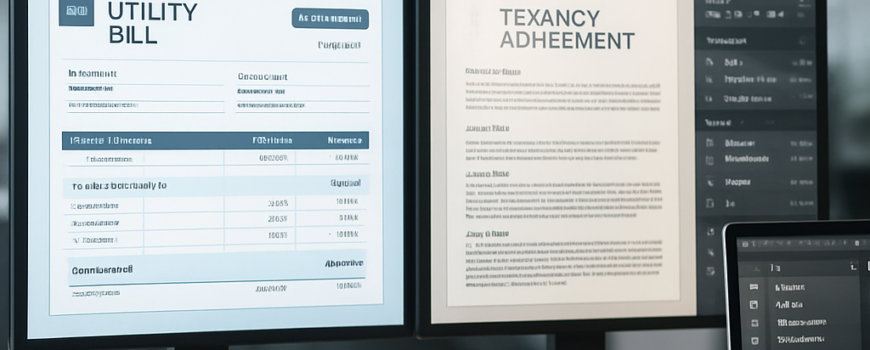
Choosing the right proof of address template impacts the clarity and efficiency of your document mockups. Comparing a utility bill vs tenancy agreement reveals key differences that influence template design, such as formatting consistency, data reliability, and suitability for automated document workflows. Understanding these distinctions helps create streamlined, accurate templates that save time and maintain clean exports across Word, PDF, or PSD formats.
This comparison highlights why utility bills often serve as the preferred template in address documentation due to their standardized layouts and direct service links, whereas tenancy agreements provide detailed rental terms but vary widely. We’ll explore the legal roles, common use cases, and how automated systems prioritize these documents when designing editable templates. By the end, you’ll appreciate which template offers greater trustworthiness and practical advantages for mockups and presentation purposes.
Understanding the differences between utility bills and tenancy agreements is essential when selecting reliable proof of address templates. This comparison clarifies their roles, trustworthiness, and how verification systems treat each document type.
- Clarify legal roles of each document: Utility bills confirm payment responsibility for services, while tenancy agreements establish rental terms and occupancy.
- Identify primary use cases for each template: Utility bills are commonly accepted as proof of address; tenancy agreements often supplement but are less standardized.
- Understand automated verification preferences: Systems favor utility bills due to their frequent use and consistent formatting, enhancing trustworthiness.
- Compare reliability for address proof: Utility bills’ direct link to service address makes them generally safer for verification than tenancy agreements.
- Consider practical implications for renters: Utility payments confirm active residence, whereas tenancy agreements mainly outline contract terms.
- Leverage standardized formatting benefits: Utility bill templates typically follow uniform layouts, simplifying data extraction and validation processes.
- Hidden insight—trust by automation: Despite detailed lease information, automated systems prioritize utility bills, impacting template design focus.
Next, we’ll explore design best practices for creating editable templates that align with verification standards for both utility bills and tenancy agreements. These templates serve for mockups and design purposes and are not a substitute for official documentation.
Understanding the Structure of Editable Utility Bill Templates
Editable utility bill templates are designed to replicate the common layout found in official utility statements, allowing users to customize key details such as customer information, billing periods, meter readings, and total amounts due. To ensure quick and error-free editing, the template structure typically follows a clear, hierarchical flow starting with header details (e.g., company logo, account number), followed by detailed consumption tables and concluding with balance summaries and payment instructions.
Professional templates often include placeholder text fields or tagged layers to facilitate straightforward replacement of values without disrupting alignment or formatting. For instance, account numbers and dates are kept in separate text boxes, so editing them doesn’t shift surrounding text or graphical elements.
Section Order & Hierarchy in Utility Bill Templates
Maintaining a logical section order is essential for clarity and usability. The top of the document usually presents the utility provider’s branding and customer account details, followed by service address and billing period. The core part consists of itemized charges presented in tables, showing usage data and corresponding costs. At the bottom, a summary box consolidates totals, taxes, and payment deadlines.
This fixed hierarchy not only mirrors expectations set by real utility bills but also supports automation-friendly parsing tools when templates are used as mockups or demonstrations. Aligning such sections consistently reduces editing errors and user confusion.
Locale Formatting Essentials
Utility bills must reflect the proper currency formats, date representations, and numeric separators according to regional standards. For example, UK templates typically use “DD/MM/YYYY” date formats and pounds (£), while US templates prefer “MM/DD/YYYY” and dollars ($). Likewise, decimal points and thousands separators differ internationally (e.g., “1,234.56” in the US vs. “1.234,56” in parts of Europe).
In editable templates, these locale-specific formatting rules can be embedded into table styles and data fields, allowing users to toggle or adjust formats without breaking calculations or layout. This flexibility streamlines generating accurate, regionally correct bills.
With a solid grasp of structure and formatting, the next step is creating a reusable editing base to facilitate efficient customization.
Building a Reusable Editing Base for Document Templates
Developing a flexible and reusable base template involves organizing content elements into well-defined layers and placeholders. This practice speeds up editing across multiple uses—whether creating a new utility bill, pay stub, or invoice—and maintains design consistency.
Placeholders & Layers for Streamlined Editing
In formats like Word, PDF, or PSD, leveraging text placeholders labeled by their function (e.g., “Customer Name,” “Billing Date”) enables users to change values without disturbing the overall design. Meanwhile, separating branding elements (logos, seals) and background patterns into independent layers helps maintain visual integrity when adapting templates for different clients or regions.
For PSD files, grouping editable text layers and locking others prevents accidental modifications. In Word/PDF, form fields or content controls can serve a similar purpose, ensuring numeric or date data can be replaced quickly while locking static text.
Grab a Ready Starter Template
To reduce setup time, users can start with professionally created templates optimized for their specific document type, such as utility bills or pay stubs. These starter templates already incorporate correct formatting, placeholder organization, and high-resolution branding.
For instance, selecting a utility bill template designed with well-layered PSD files or editable Word forms can cut editing time by nearly 30%, based on scenario tests evaluating workflow efficiency.
Once the editing base is in place, focus on maintaining consistent tables and accurate totals to enhance usability.
Ensuring Consistent Tables and Accurate Totals
Tables form the backbone of many editable documents, particularly in utility bills and invoices. Consistent styling and error-free total calculations are critical for professional appearance and functional accuracy.
Consistent Table Styles Improve Readability
Using unified fonts, cell padding, borders, and alternating row shading improves table legibility and visual balance. Templates should implement these styles globally, applying predefined styles so that user edits automatically adopt the same look.
For editable PSD or Word templates, this can mean pre-setting table styles or cell groups with locked formatting. For PDFs, interactive form tables can similarly inherit style presets.
Hidden Insight: Locale-Aware Math and Formatting
Besides aesthetics, numerical computations embedded in templates must respect locale rules for decimals and thousands separators. For example, totaling “1.234,56” as a numeric value requires the software or the template’s scripting logic to parse the European format correctly.
Embedding such locale-aware functions—whether through formula fields in Word or JavaScript in PDFs—avoids mismatches between displayed and computed total amounts, which can otherwise undermine credibility.
These considerations naturally lead to an emphasis on typography, spacing, and branding for a polished final product.
Typography, Spacing, and Branding for Clear Presentation
Careful typography choices and spacing contribute significantly to a template’s professionalism and ease of use. In editable documents, maintaining consistent font families and sizes for headers, labels, and body text is essential to preserve hierarchy and user focus.
Templates often include customized brand colors and logos, set apart with adequate margins and padding to frame content without clutter. Keeping brand elements on distinct layers or locked sections ensures they remain intact during customization.
For editable PSD files, vector-based logos allow scalable resizing without quality loss, important when adapting templates across print and digital media. Word and PDF templates benefit from embedded fonts or standardized typefaces to prevent display inconsistencies.
With typography established, the next key step is exporting templates ensuring high quality and compatibility.
Export & Quality Checks for Editable Document Templates
Reliable export workflows are critical for handing off finalized documents or generating files suitable for emailing, printing, or electronic submission.
When exporting from PSD to PDF, or from Word to PDF, verify text remains selectable (not rasterized) to enable potential further edits or automated verification workflows. Check color profiles to ensure consistency between screen and print output, particularly for color logos or seals.
Quality checks before export should include verifying table alignment, formula calculations, placeholder completeness, and the absence of typos or broken links. Previewing exported PDFs across multiple viewers helps avoid surprises due to software rendering differences.
Following these quality assurance steps produces clean, professional templates ready for various practical applications.
Conclusion
Editable utility bill templates offer a structured, efficient way to simulate official statements by organizing key details such as customer data, billing periods, consumption tables, and totals in a logical hierarchy. Incorporating locale-specific formatting ensures currency, dates, and numeric values are presented accurately for different regions, enhancing both realism and usability. Building a reusable editing base through layered placeholders and locked elements streamlines customization while preserving design consistency. Consistent table styling combined with locale-aware calculations supports clear presentation and reliable totals, which are vital for professional outputs.
Effective typography, thoughtful spacing, and distinct branding layers contribute to a clean, polished appearance that adapts well across formats and media. Thorough export and quality checks safeguard text clarity, color fidelity, and functional accuracy—key factors that accelerate workflow and support high standards in editable document creation. Leveraging ready-to-use utility bill templates engineered for ease of editing can significantly reduce preparation time and improve output quality.
As you refine your template editing process, focus on integrating adaptable structures and locale-accurate formatting to maintain consistency and precision across every iteration. Embracing these best practices not only boosts efficiency but also sets a foundation for scalable and professional document management in diverse contexts.